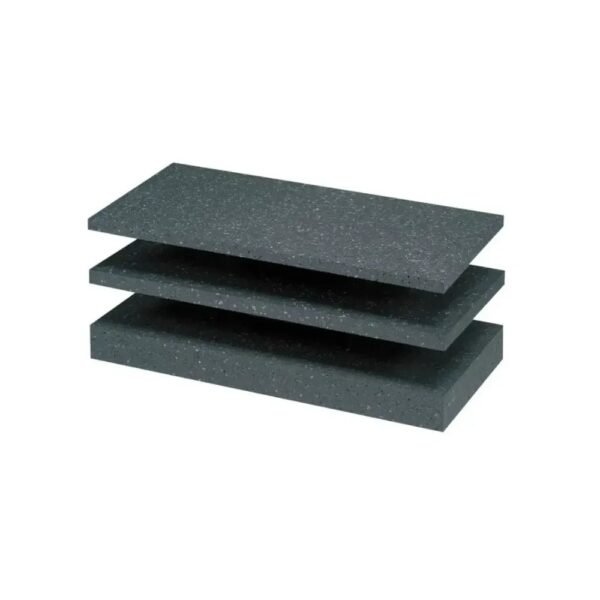
EPS Insulation Boards - Expanded Polystyrene Rigid Foam Panels
Rigid, lightweight and thermally stable - expanded polystyrene (EPS) insulation boards are a proven choice for walls, roofs, foundations and below-grade applications. Built to deliver consistent R-values for the lifetime of the building, with no off-gassing and no performance decay.
What Are EPS Insulation Boards?
EPS insulation boards are rigid foam panels manufactured from expanded polystyrene - one of the most widely used thermal insulation materials in commercial and residential construction. Their combination of structural reliability, long-term R-value retention and straightforward installation has made them a standard component in building envelopes across the globe.EPS boards are produced in a two-stage process. First, raw polystyrene beads are pre-expanded using steam, causing them to increase in volume by up to 50 times. The expanded beads are then moulded and fused together under heat and pressure, forming a rigid, closed-cell panel. The result is a lightweight, dimensionally stable board made up of approximately 98% trapped air and 2% polystyrene - a structure that gives EPS its characteristic thermal resistance.Unlike some competing insulation types, EPS contains no blowing agents that degrade over time. The air locked inside the cells remains stable, which means the R-value measured on day one is the same R-value the board delivers 20 or 30 years later. This is one of the most important practical distinctions between EPS and other rigid foam products.
How EPS Foam Is Manufactured
The manufacturing process begins with expandable polystyrene beads - small spheres containing pentane as an expansion agent. In the pre-expansion phase, steam is applied to the beads at controlled temperatures, causing them to soften and expand around the pentane vapour. The beads are then stabilised and allowed to cure before being transferred to a mould.Inside the mould, the pre-expanded beads are subjected to steam pressure again. The beads expand further, fuse together at their surfaces and fill the mould cavity completely. Once cooled, the resulting block is cut into boards of specified thickness using hot-wire cutting equipment, which produces clean, precise edges with minimal waste. The finished boards are then tested for density, compressive strength and thermal performance before dispatch.Density is a critical parameter controlled during this process. Higher steam pressure and longer moulding times produce denser boards with greater compressive strength. Lower densities are suitable for standard wall and roof applications; higher densities are specified where load-bearing capacity is required - such as below concrete slabs, in road construction or on flat commercial roofs subject to foot traffic.
EPS vs XPS vs Polyiso - Key Differences
EPS is one of three widely used rigid foam insulation types. Understanding the differences helps specify the right product for each application.
| Property | EPS (Expanded Polystyrene) | XPS (Extruded Polystyrene) | Polyiso (Polyisocyanurate) |
|---|
| R-value per inch | ~R-3.8 to R-4.4 | ~R-4.5 to R-5.0 | ~R-5.6 to R-6.8 |
| R-value stability | Permanent - no off-gassing | Degrades over time (blowing agent loss) | Stable but reduces at low temperatures |
| Moisture absorption | Below 5% by volume (long-term) | Above 18% by volume (long-term) | Moderate - requires facers |
| Compressive strength | 10-60 psi (density-dependent) | 25-100 psi | Up to 25 psi |
| Cost | Low to moderate | Moderate to high | High |
| Below-grade suitability | Excellent | Good | Poor without protection |
| Recyclability | Yes - widely recyclable | Limited | Limited |
Technical Properties and R-Value Performance
Understanding how EPS performs thermally - and how density and thickness interact - is essential for accurate specification. The relationships are straightforward, which makes EPS one of the easiest insulation materials to model and verify.
R-Value by Thickness - EPS Insulation Chart
EPS adds thermal resistance in a linear, predictable way as thickness increases. This makes it straightforward to specify: if a project requires R-20, the calculation is direct. At standard density (1 lb/ft³), each inch of EPS provides approximately R-3.85. At higher densities (1.5-2 lb/ft³), the R-value per inch rises to approximately R-4.0 to R-4.4. The following chart covers the most commonly specified thicknesses.
| Thickness (inches) | Thickness (mm) | R-Value (1 lb/ft³) | R-Value (1.5 lb/ft³) | R-Value (2 lb/ft³) |
|---|
| 1" | 25 mm | R-3.85 | R-4.00 | R-4.17 |
| 1.5" | 38 mm | R-5.78 | R-6.00 | R-6.25 |
| 2" | 51 mm | R-7.70 | R-8.00 | R-8.35 |
| 3" | 76 mm | R-11.55 | R-12.00 | R-12.50 |
| 4" | 102 mm | R-15.40 | R-16.00 | R-16.70 |
| 5" | 127 mm | R-19.25 | R-20.00 | R-20.85 |
| 6" | 152 mm | R-23.10 | R-24.00 | R-25.00 |
| 8" | 203 mm | R-30.80 | R-32.00 | R-33.35 |
| 10" | 254 mm | R-38.50 | R-40.00 | R-41.70 |
Density, Compressive Strength and What They Mean in Practice
Density is the specification variable most often overlooked in EPS selection - yet it directly controls both compressive strength and R-value. EPS is available in a range of densities, typically from 0.7 lb/ft³ to 3 lb/ft³ (11-48 kg/m³), each corresponding to a defined compressive strength.
| Density (lb/ft³) | Compressive Strength (psi) | Common Applications |
|---|
| 0.9 - 1.0 | 10-13 psi | Wall cavity, interior walls, light-duty continuous insulation |
| 1.25 - 1.5 | 18-25 psi | Exterior wall sheathing, EIFS systems, roofing |
| 1.5 - 2.0 | 25-35 psi | Below-grade walls, flat roofs with foot traffic, radiant floor systems |
| 2.0 - 2.5 | 35-50 psi | Under concrete slabs, car parks, highway embankments |
| 3.0+ | 60+ psi | Heavy-load applications, cold storage floors, industrial pavements |
Specifying the correct density for each application is important both for structural reasons and to avoid over-specifying. In a standard EIFS wall system, a 1.25-1.5 lb/ft³ board is entirely adequate. Under a concrete floor slab bearing vehicle loads, the same density would deform under sustained load - a 2.5 lb/ft³ or higher grade is required. When in doubt, consult the compressive load calculations for the specific assembly.
Applications - Where EPS Insulation Boards Are Used
EPS rigid boards are used across virtually every zone of a building envelope. Their combination of structural versatility, moisture management and dimensional stability makes them suitable from the foundation up to the roof membrane.
Wall Insulation (Exterior and Cavity Walls, EIFS Systems)
Wall insulation is the most common application for EPS boards in residential and commercial construction. EPS provides continuous insulation (CI) on the exterior face of a building, eliminating the thermal bridging that occurs with stud-only insulation assemblies. Continuous insulation requirements are now embedded in energy codes including ASHRAE 90.1 and IECC, which has made exterior EPS boards a standard specification element in new construction.In Exterior Insulation and Finish Systems (EIFS), the EPS board serves as the insulating substrate over which a reinforced base coat and decorative finish are applied. EPS used in EIFS typically ranges from 1" to 6" in thickness depending on climate zone requirements. It can be adhesively or mechanically attached, and its surface can be rasped to conform to irregular substrates or shaped for architectural profiles. EPS is an ASTM E2430-certified substrate for EIFS applications and is listed by leading EIFS manufacturers including Dryvit, Sto and Finestone.For cavity wall applications, EPS boards are installed between the inner leaf and the outer masonry veneer, providing a thermal break and reducing the overall U-value of the wall assembly. Boards up to 4" thick are commonly used in cavity wall construction, with tongue-and-groove edge profiles available to eliminate air pathways at board joints.
Roof and Flat Roof Insulation
EPS is well established in both pitched roof and flat roof insulation. On flat commercial roofs, EPS boards are installed below the waterproofing membrane in a conventional or protected membrane assembly. The boards are available in tapered configurations to provide positive drainage slope - typically cut to specified pitches of 1/8" to 1/2" per foot - eliminating the need for structural crickets on large roof areas.EPS is compatible with a wide range of roofing membranes including EPDM, PVC, TPO, modified bitumen and built-up roofing. It is approved as a substrate by most major membrane manufacturers when installed in accordance with the relevant FM or UL system listing. Density selection for roofing applications should account for anticipated foot traffic: a 1.5 lb/ft³ board is suitable for roofs with minimal maintenance access, while 2 lb/ft³ is recommended where regular traffic is expected.In residential pitched roof applications, EPS boards are used on the warm side of the rafters or between rafters in hybrid assemblies. The material is easy to cut with a box knife or handsaw, which reduces installation labour on complex roof geometries.
Foundation, Below-Grade and Floor Insulation
EPS performs exceptionally well in below-grade applications - a distinction it holds over both XPS (which absorbs significantly more moisture long-term) and polyiso (which requires additional protection in damp environments). EPS boards installed on the exterior of foundation walls provide a thermal barrier while also protecting the waterproofing membrane from backfill damage. Special drainage-profile EPS boards are available for this application, incorporating vertical channels that direct groundwater away from the foundation.Under concrete floor slabs, EPS boards interrupt the thermal conduction path between the slab and the cold ground below. This is particularly important in passive house construction, where foundation insulation is a mandatory component of the building envelope performance model. EPS boards rated at 25-40 psi compressive strength are typically specified under slabs in residential construction; heavier loads (vehicle access, industrial floors) require higher densities.EPS is also the primary insulation substrate used in hydronic radiant floor systems. Pre-formed EPS panels with surface knobs or channels are available to locate PEX tubing at precise spacing, eliminating the need for separate stapling and reducing installation time. Standard 4x8 flat EPS boards at 1" to 4" thickness are used where PEX is attached separately to rebar or mesh prior to the concrete pour.
Exterior wall / EIFS
Continuous insulation layer, architectural finish substrate, ASTM E2430 certified
Cavity wall
Thermal break between inner leaf and masonry veneer, tongue-and-groove profile
Flat roof
Below-membrane insulation, tapered for drainage, FM/UL-listed assemblies
Pitched roof
Over-rafter boards or hybrid between-rafter assemblies in residential construction
Foundation / below grade
Exterior foundation insulation with drainage profile, waterproofing protection
Concrete floor slab
Sub-slab insulation for passive house, radiant floor PEX substrate boards
Key Benefits of EPS Rigid Foam Boards
EPS does not rely on performance claims that fade over time. Its most important advantages are structural and measurable - things that can be verified in field data over decades of use.
Long-Term R-Value Stability - No Off-Gassing
The R-value of an EPS board on the day it is installed is the same R-value it delivers throughout the life of the building. This matters because several competing products - notably XPS - use hydrofluorocarbon (HFC) blowing agents that gradually diffuse out of the foam cells after installation. As the blowing agent escapes, the air that replaces it has lower thermal resistance, and the effective R-value of the board decreases. This process is sometimes called "thermal drift" or R-value aging.EPS uses air - not HFC gas - as the primary insulating medium. There is no proprietary gas to escape, and no degradation mechanism for the thermal resistance of the product. Energy codes and building performance models that use EPS R-values at time of installation remain accurate across the service life of the assembly. This is a straightforward, verified advantage that simplifies long-term energy modelling for design professionals.
Moisture Resistance and Breathability
EPS has a closed-cell structure that resists liquid water intrusion while remaining semi-permeable to water vapour. This behaviour is frequently mischaracterised: EPS is not waterproof, but it manages moisture in a way that is beneficial in many building assemblies. The water vapour permeability of EPS (typically 2-5 perms at 1" thickness) allows moisture to move through the material and exit to the exterior, preventing the accumulation of condensation within the wall assembly.In below-grade applications, the key metric is long-term water absorption by volume. Independent testing has shown that EPS absorbs less than 5% water by volume after extended exposure - a level that does not meaningfully affect thermal performance. This compares favourably to XPS, which has been documented absorbing over 18% water by volume in the same period, with corresponding R-value loss.The moisture management characteristics of EPS make it well suited to assemblies that need to dry in one or both directions - such as below-grade walls and floor slabs in climates with seasonal moisture variation.
Lightweight, Easy to Cut and Install
A standard EPS board weighs between 0.2 and 0.6 lb/ft² depending on thickness and density - typically 5 to 8 times lighter than equivalent insulation thickness in mineral wool. This reduces handling labour, lowers structural loads on the building, and makes repositioning boards during installation straightforward without specialist equipment.EPS boards can be cut with a sharp box knife, handsaw or hot-wire cutter. Unlike foil-faced products, EPS requires no scoring before cutting and produces clean edges without delamination. Boards can be shaped on-site to accommodate architectural profiles, penetrations, window reveals and irregular substrates. This adaptability reduces waste and allows continuous insulation to be maintained around complex geometries without thermal bridges.
Stable R-value for life
No off-gassing, no thermal drift. R-value at installation equals R-value at year 30.
Low moisture absorption
Below 5% water absorption by volume long-term. Performance maintained in damp conditions.
Lightweight and manageable
5-8x lighter than mineral wool equivalents. Reduces structural load and handling labour.
Easy on-site fabrication
Cut with a box knife or handsaw. Shaped to any profile. No specialist tools required.
Recyclable
EPS is widely recyclable at end of service life. Many manufacturers offer take-back programmes.
Dimensionally stable
Does not creep, settle or compress under sustained load within specified density range.
How to Choose the Right EPS Board - Thickness and Density Guide
Selecting the correct EPS board involves two independent decisions: the density (which determines structural capacity) and the thickness (which determines R-value). These two parameters are chosen independently - a high-density board does not need to be thicker to achieve the same R-value as a low-density board, though denser boards have a marginally higher R-value per inch.Start with density. Ask: will this board be subject to compressive loads beyond its own weight? If the board is in a wall cavity or on a roof where there is no sustained point load, a 1 lb/ft³ board is adequate. If the board will bear the weight of a concrete slab, structural fill or vehicle traffic, calculate the anticipated compressive stress and select a density rated above that figure with a suitable safety factor.Then determine thickness from the required R-value. Use the R-value per inch for the selected density from the chart in the previous section, divide the target R-value by the per-inch value, and round up to the next available thickness. EPS boards are commonly available in 1/2" increments from 1" to 6", with thicker boards typically cut to order.
Quick selection guide by application
1" - 2"
Exterior wall sheathing in mild climates (Climate Zones 1-3). Supplemental layer in hybrid assemblies. EIFS systems where primary insulation is within the wall cavity.
2" - 3"
Exterior continuous insulation in Climate Zones 4-5 meeting ASHRAE 90.1 requirements. Sub-slab insulation in residential construction. Foundation wall insulation.
3" - 4"
Exterior wall CI in Climate Zones 6-7. Flat roof insulation providing R-15 to R-20 as part of a larger assembly. Passive house wall assemblies.
4" - 6"
High-performance flat roofs in cold climates. Passive house foundations and below-grade walls. EIFS assemblies in Climate Zones 7-8.
6" and above
Ultra-low-energy building envelopes. Deep energy retrofits. Commercial cold storage applications. Often achieved using two layers of board with staggered joints.
EPS Insulation Boards - Compliance and Building Codes
EPS insulation boards are tested and certified under a range of national and international standards. Understanding the applicable codes helps verify that the specified product meets the requirements of the authority having jurisdiction before installation begins.
ASHRAE 90.1, IECC and Energy Code Requirements
ASHRAE 90.1 (Energy Standard for Buildings Except Low-Rise Residential) is the primary energy code reference for commercial construction in the United States and forms the basis for many international equivalents. The standard prescribes minimum continuous insulation R-values for each climate zone and assembly type. EPS boards, when used as continuous insulation on the exterior face of a wall or roof assembly, directly satisfy the CI requirements of ASHRAE 90.1-2019 and its successors when specified at the correct thickness and density.The International Energy Conservation Code (IECC) aligns with ASHRAE 90.1 for commercial buildings and provides its own prescriptive R-value tables for residential construction. EPS boards used as exterior sheathing in residential assemblies comply with IECC 2021 continuous insulation requirements when the correct thickness is specified for the applicable climate zone.EPS boards used in EIFS applications are listed under ICC Evaluation Service Reports (ICC-ESR), which confirm compliance with the 2021 International Building Code (IBC) and International Residential Code (IRC) for use in specific system assemblies. When fire-resistance-rated wall assemblies are required, the relevant ESR (for example ICC-ESR 1748 for certain EIFS systems) specifies the approved EPS board types and thicknesses that maintain the fire rating.The primary material standard for EPS insulation in the US is ASTM C578. This standard defines the physical and thermal performance requirements for each type of EPS board. Specifying "ASTM C578 Type II" or "ASTM C578 Type IX" in project documents, for example, sets defined minimum requirements for density, compressive strength, R-value and water absorption that any compliant EPS product must meet - regardless of manufacturer.