
Why this matters: The best external wall insulation boards can still fail if the system is mismatched. Think in systems – boards + fixings + basecoat + mesh + finish.
What are external wall insulation boards?
External wall insulation boards are rigid or semi-rigid insulation panels fixed to the outside of a building. They are then finished with a reinforced basecoat and a decorative render (insulated render system) or a cladding build-up.
As part of an external wall insulation (EWI) system, these boards improve thermal performance, help reduce heat loss and can refresh the look of a facade – especially on solid wall properties.
- Best for: solid wall homes, retrofit upgrades, low-energy renovations
- Also used for: selected new build facades with rendered finishes

How an external wall insulation system works
External insulation boards are only one layer of the full build-up. A typical system includes:
- Adhesive (or adhesive + mechanical fixings)
- External wall insulation boards
- Reinforcing mesh embedded in a basecoat
- Primer
- Final finish – render or compatible cladding
Compatibility is key.Always choose boards that are approved for the render/cladding system you plan to use. Mixing random components is one of the fastest ways to get cracking, debonding or moisture issues.
Types of external wall insulation boards (UK)
EPS external wall insulation boards (expanded polystyrene)
EPS insulation boards are among the most common choices for external wall insulation in the UK thanks to a strong balance of cost, performance and ease of installation.
- Good thermal performance for the price
- Lightweight and quick to fit
- Widely compatible with insulated render systems
Mineral wool external wall insulation boards
Mineral wool (stone wool/rock wool) boards are often selected where fire performance and acoustics are priorities. They are typically vapour permeable and robust, but usually require more thickness to hit the same U-value as higher-performance foams.
- Non-combustible options are common for stricter fire requirements
- Excellent sound reduction
- Vapour permeable – useful where breathability is important
Phenolic insulation boards
Phenolic boards are used when you need strong thermal performance with less build-up thickness. They can be a good fit for facade constraints in dense urban areas.
- Very low lambda (high thermal efficiency)
- Thinner insulation for the same target U-value
- More premium price point
PIR and PUR external insulation boards
PIR/PUR boards are rigid foam products sometimes used in EWI. They are typically installed within manufacturer-approved systems and are less universal than EPS or mineral wool in UK external wall insulation.
- Good thermal efficiency
- Rigid structure
- Usually specified as part of a branded system
Comparison of external wall insulation boards
How to choose the right external wall insulation boards
The right EWI boards depend on your building type, performance target and finish. Use the checklist below when specifying external insulation boards.
1) Fire safety and building regulations
Fire performance can be a deciding factor, especially for multi-storey buildings. In many cases, mineral wool solutions are chosen to meet stricter requirements.
2) Target U-value and available thickness
If facade thickness is limited (boundaries, reveals, roof details), higher-performance boards like phenolic can help meet targets with less build-up.
3) Budget and value per m2
EPS external wall insulation boards often deliver the best cost-to-performance ratio for typical residential retrofits.
4) Finish type – insulated render vs cladding
Always match the board to the approved system for your finish. Not all boards are suitable for every render or cladding specification.
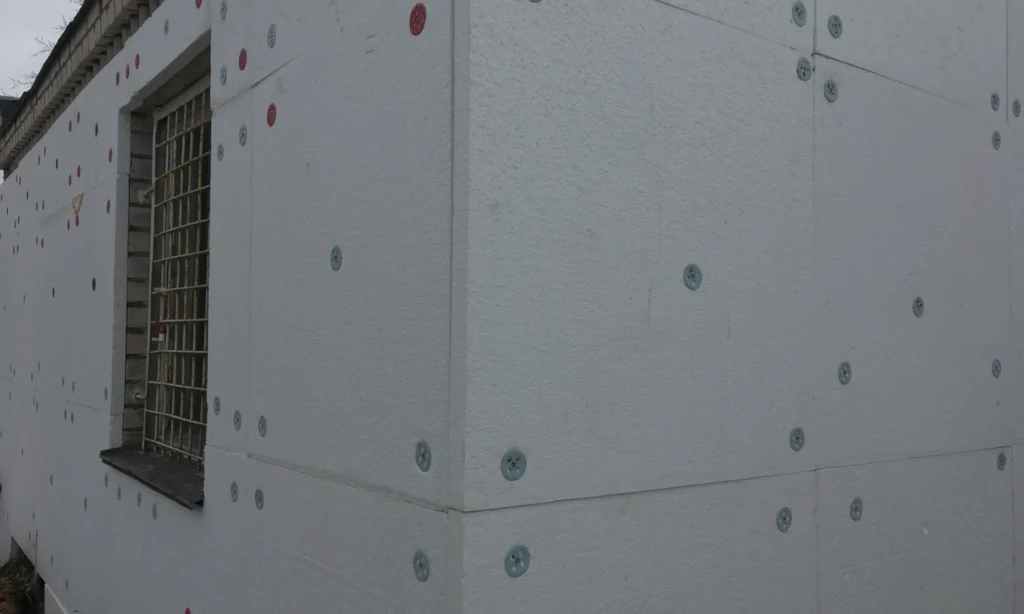
Installation basics – what matters most
Even premium external wall insulation boards will underperform if installed poorly. Focus on the fundamentals:
- Good surface preparation and adhesion
- Correct adhesive coverage (avoid hollow spots)
- Proper mechanical fixing pattern where required
- Tight joints and clean detailing around openings
- Full mesh embedment and correct basecoat thickness
- Weather-aware scheduling (avoid freezing/soaking conditions)
Benefits of external wall insulation boards
- Reduced heat loss through walls
- Lower heating costs and improved comfort
- Protection of the original wall structure
- Facade transformation with a modern render finish
- Potential uplift in property value
Common mistakes to avoid
- Choosing boards based only on price
- Ignoring fire requirements and system approvals
- Mixing incompatible adhesives, meshes and finishes
- Under-specifying thickness and expecting miracles
- Weak detailing at windows, doors, corners and plinths
FAQ – external wall insulation boards
They are ideal for solid wall properties and many retrofit projects. Homes with cavity walls may not need EWI unless extra performance or a facade upgrade is required.
There is no single best option. EPS, mineral wool and phenolic boards each suit different budgets, thickness constraints and regulatory requirements.
When installed correctly as part of a certified EWI system, they can last for decades with straightforward maintenance.
Small test areas might be possible, but full EWI systems are best installed by experienced professionals to avoid thermal bridging, cracking and moisture issues.